
Build First, Plan Later: What My 3-Year-Old Knows About Making Things
Why tinkering without a plan teaches kids computational thinking better than any curriculum — backed by Papert, Turkle, and a pile of blocks

My son was playing with blocks yesterday. I wasn’t directing him. I was just watching.
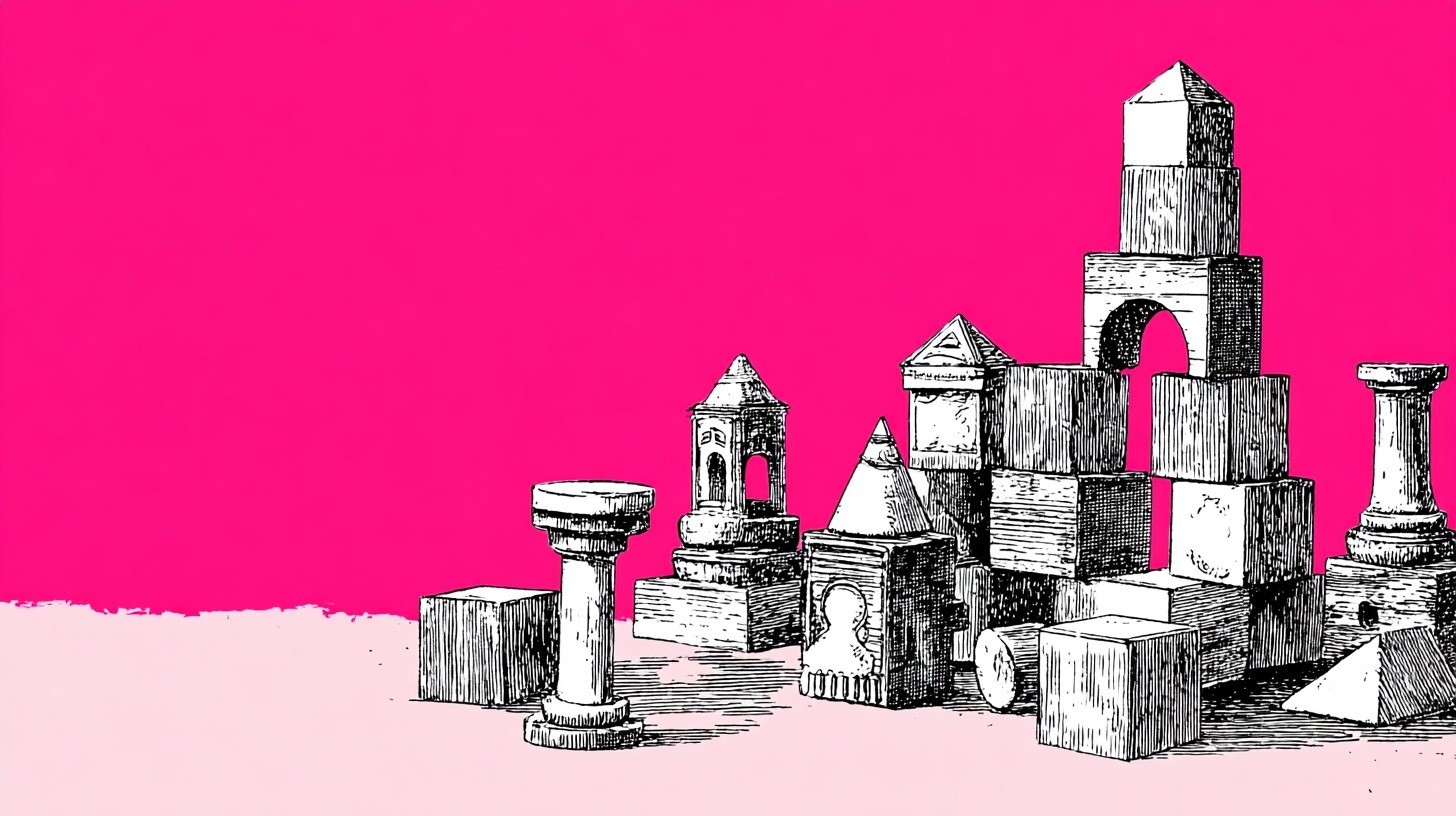
He stacked two triangular prisms together and ran a matchbox car down the slope. A ramp.
Then he added a flat block at the top. Now the car could drive up the ramp onto a platform. The ramp wasn’t a ramp anymore — it was a driveway.
Then he added a gantry over the platform. Declared the whole thing a race course. Started lining up cars at the top.
He didn’t sit down and think “I’m going to build a race course.” He built a ramp, and the ramp told him what it wanted to be next.
The Bricoleur
In 1962, anthropologist Claude Lévi-Strauss described two fundamentally different ways humans create things. The engineer starts with a plan — a blueprint, a specification, a clear picture of the end goal — and then acquires the exact materials needed to execute it. The bricoleur starts with whatever’s at hand and builds by rearranging, adapting, and responding to what emerges.
Lévi-Strauss wasn’t ranking them. He was arguing they’re equally sophisticated ways of thinking. But if you’ve spent any time in schools or workplaces, you know which one gets all the respect.
Almost thirty years later, MIT researchers Sherry Turkle and Seymour Papert observed the same split in how children learn to program. Some kids planned their program top-down: outline the structure, define the functions, then fill in the details. Others — the bricoleurs — came up with a set of instructions, ran it, reacted to what happened, adjusted, ran it again. They were in conversation with the material.
The planners’ result wasn’t better. It was just more legible to teachers who’d been trained to value planning. Turkle and Papert called this bias a failure of “epistemological pluralism” — a fancy way of saying we only recognize one style of thinking as real thinking.
My three-year-old doesn’t know any of this. He just builds the way that feels natural, which happens to be the way Lévi-Strauss described, Turkle and Papert validated, and every maker space on earth now tries to teach back to adults.
What the Blocks Are Saying
Here’s the thing about the race course: each step made sense only in context of the step before it.
The platform made sense because the ramp existed. The gantry made sense because the platform existed. If you’d asked my son at the beginning “what are you building?” he would have said “a ramp” — because that’s all it was. The race course didn’t exist yet. It couldn’t exist yet. It emerged from the building.
This is what Papert meant when he described learning as a conversation between the builder and the thing being built. The blocks aren’t passive raw materials. They’re participants. Every time my son placed one, the structure changed — and the changed structure suggested new possibilities. The ramp became an entryway the moment the platform appeared beside it. The context shifted.
Mitchel Resnick, Papert’s student at MIT and the creator of Scratch, later formalized this as the Creative Learning Spiral: imagine, create, play, share, reflect, imagine again. It’s the cycle that drives kindergarten — and, he argues in Lifelong Kindergarten, it’s how the most creative work happens at every age. We just stop calling it learning and start calling it “iterative design” or “rapid prototyping” somewhere around middle school.
What We Train Out of Them
Every formal education system I’ve encountered — and I went through a lot of them to earn my Masters — eventually teaches children to plan before they build. Outline before you write. Spec before you code. Know what you’re making before you start making it.
This is useful. I’m not arguing against blueprints. If you’re building a bridge, please have a blueprint.
But there’s a cost to making planning the only acceptable mode. When “what are you building?” always requires a confident answer before you’re allowed to pick up the materials, you lose something. You lose the willingness to start without knowing where you’ll end up. You lose the ability to let the work talk back to you. You lose the ramp that becomes a race course.
Turkle and Papert saw this concretely: children who naturally built in the bricoleur style were marked down, redirected, told to “plan it out first.” Not because their programs didn’t work — they worked fine — but because the process looked wrong to adults who’d been trained in the engineering style.
Papert spent his career pushing back on this. His argument wasn’t that planning is bad. It was that we systematically undervalue building-as-thinking. When a kid stacks blocks and discovers something he didn’t intend, that’s not a failure of planning. That’s cognition. That’s how humans have made things for most of our history. The blueprint is the newcomer.
The Feedback Loop
What makes my son’s block play look like play and a designer’s prototype sprint look like work? (A paycheck?)
Build something small. Look at what you built. Respond to what you see. Build the next thing. The feedback loop is the same whether you’re three years old with wooden blocks or thirty years old with a Figma prototype.
The race course emerged from forty-five seconds of iterative building. Ramp → platform → gantry → “it’s a race course!” Each cycle took maybe ten seconds. No hesitation. No “is this good enough to show someone?” Just build, observe, respond.
This is the loop I try to protect. Not because I want to raise a kid who never plans — he’ll learn that skill, and it’s a good one. But because the instinct to start building and let the thing tell you what it wants to be is rare and valuable and very, very easy to train out of someone.
Try This
Next time your kid is building something — blocks, LEGO, a pillow fort, a drawing — resist the urge to ask “what are you making?” at the beginning.
Just watch.
Watch how each piece responds to the last. Watch the project change identity midstream. Watch a tower become a bridge become a house become a rocket ship. That’s not indecision. That’s a conversation between a builder and a material, playing out in real time.
That’s the feedback loop that drives all creative work. Your kid just hasn’t learned to be self-conscious about it yet.
Protect that.
This essay is part of the thinking behind 12 Weeks of Tech Projects to Build With Your Kid — a curriculum designed around exploration-first learning for ages 2-6.
References
Lévi-Strauss, C. (1962). The Savage Mind. University of Chicago Press.
Turkle, S. & Papert, S. (1990). “Epistemological Pluralism: Styles and Voices within the Computer Culture.” Signs, 16(1), 128-157.
Papert, S. (1980). Mindstorms: Children, Computers, and Powerful Ideas. Basic Books.
Resnick, M. (2017). Lifelong Kindergarten: Cultivating Creativity through Projects, Passion, Peers, and Play. MIT Press.