
Computational Thinking Milestones: What to Expect from Ages 1 to 4
Your kid is already a computer scientist. Here’s the developmental timeline nobody wrote.

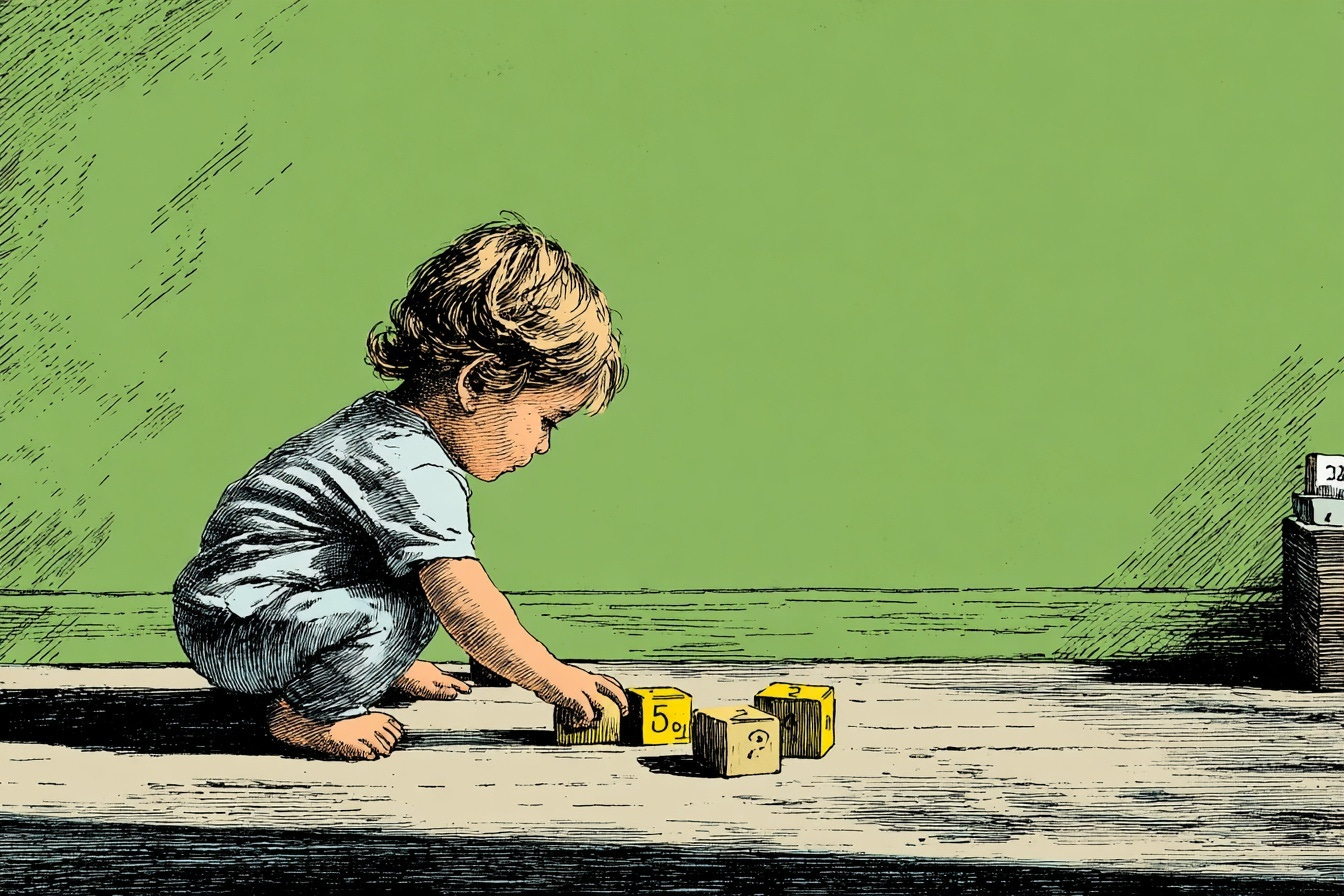
There’s no shortage of developmental milestone charts. Rolling over by 4 months. First words by 12 months. Riding a bike by 5. Pediatricians have these mapped to the month.
But computational thinking? The skill set that arguably matters more than any other in the 21st century? Just vague advice to “introduce coding” at some undefined future date, usually involving an 8-year-old, a $200 robot, or a lot of screen time.
When I went from engineering director to SAHM, I realized that computational thinking isn’t some vague future course you’ll have to remember to enroll your kid in. Toddlers do it every day when they play with blocks, decide which clothes to wear, or negotiate for “one more story.” So I wrote the guide to toddler CS milestones that I couldn’t find.
This isn’t academic theory (though the research backs it up — Marina Umaschi Bers at Boston College has been studying computational thinking in early childhood for over a decade, and Jeannette Wing’s foundational paper on computational thinking made the case that it’s a universal skill, not just a CS major thing). This is what I’ve watched happen with my own kid, mapped against what developmental science tells us to expect. If your child is doing some of these things and not others, that’s normal. Kids aren’t firmware updates. They don’t all install features on the same schedule.
But it’s useful to know what you’re looking at.
Age 1-2: The Hardware Installation
Think of this phase as your child’s operating system booting up. They’re not “doing” computational thinking yet in any way you’d recognize. They’re building the prerequisite hardware: cause and effect, object permanence, basic categorization.
What you’ll see:
Cause and effect loops. Drop the spoon, it falls. Drop it again, it falls again. Drop it thirty-seven more times because apparently the experiment needs replication. This is your child discovering that actions have predictable, repeatable outcomes — the absolute foundation of algorithmic thinking.
Basic sorting by single attribute. Putting all the red blocks in one spot. Pulling all the books off the shelf (organizing by... accessibility?). They can group by at least one feature: color, shape, size.
Sequential imitation. Copying a two-step action: open the cabinet, pull out the pot. They can’t invent sequences yet, but they can replicate short ones. That’s the beginning of following instructions — which is the beginning of understanding what instructions are.
Trial and error without strategy. They’ll try to fit the square block into the round hole repeatedly, then accidentally succeed with the right one. No hypothesis yet. Just brute force. (But honestly, I’ve seen senior engineers debug this way too.)
What you won’t see (and that’s fine):
Planning. Abstraction. Multi-step reasoning. The prefrontal cortex is barely online. Don’t worry about it.
What to do:
Narrate cause and effect. “You pushed the ball and it rolled!” Name categories out loud: “That’s a big one. That’s a small one.” Let them fail at shape sorters. Some frustration is a motivator for learning.
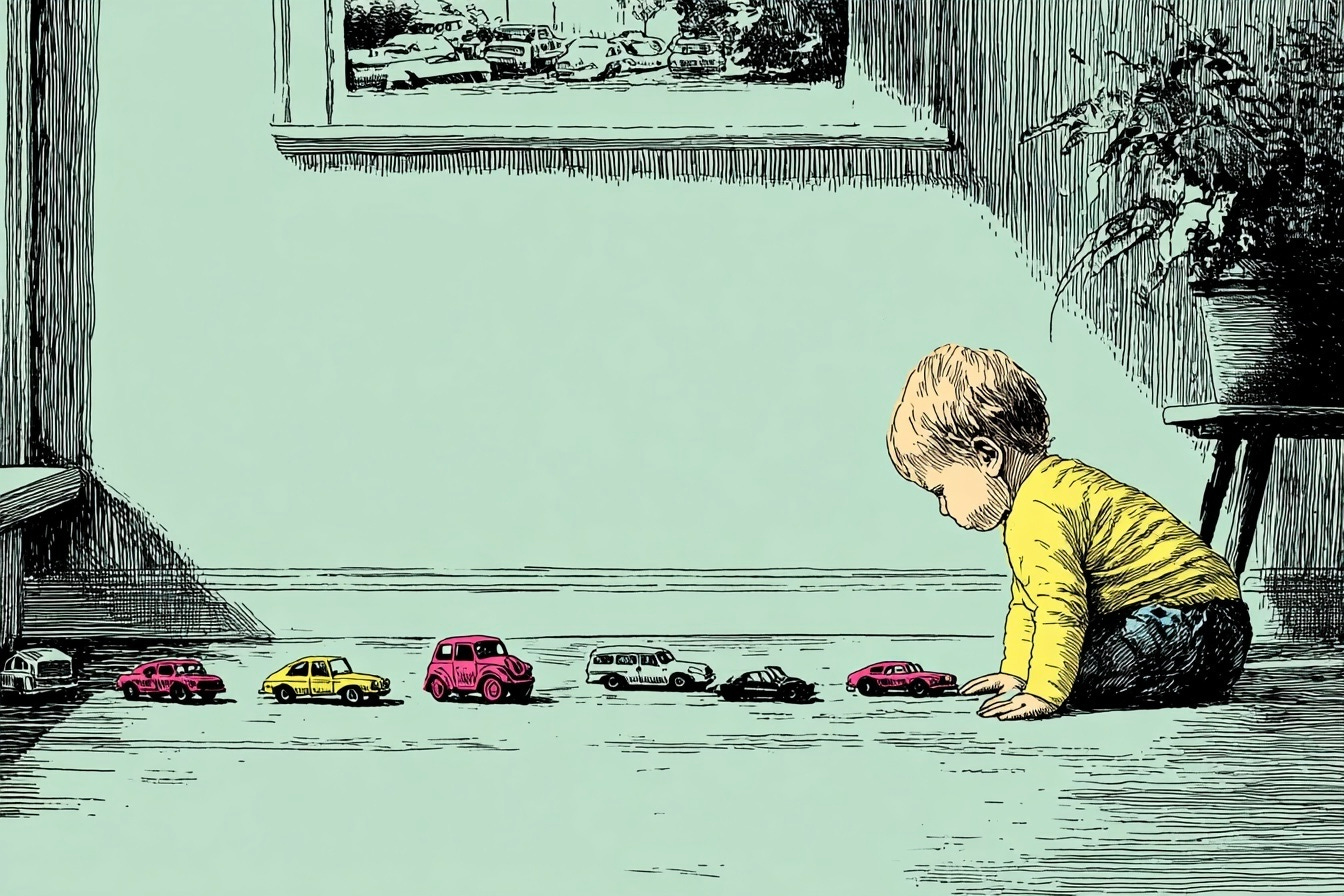
Age 2-3: First Programs
This is when it gets interesting. Language explodes, and with language comes the ability to describe sequences, not just imitate them. Your child starts writing their first programs — they just don’t know it.
What you’ll see:
Verbal sequencing. “First shoes, then outside.” They can describe a 2-3 step plan before doing it. This is pseudocode. Actual, literal pseudocode, just spoken by someone who pronounces “spaghetti” as “pasketti.”
Multi-attribute sorting. “Big red cars here, small red cars there.” Two sorting criteria at once. This is a compound query.
SELECT * FROM toys WHERE color = 'red' ORDER BY size.If/then reasoning (basic). “If it’s raining, we need boots.” They start predicting outcomes based on conditions. It’s not consistent yet — they might also predict that putting on boots will make puddles appear — but the structure of conditional logic is emerging.
Pattern completion. Red, blue, red, blue, red. They can extend a simple AB pattern. Some kids start inventing their own patterns: “car, truck, car, truck.” This is the absolute seed of algorithmic thinking — recognizing a rule and applying it.
Debugging with intention. The block tower falls and instead of random retry, they adjust. Bigger block on the bottom this time. They’re forming hypotheses about why things failed, even if the hypothesis is wrong. The method matters more than the accuracy.
What you won’t see:
Nested logic (”if it’s raining AND cold, we need boots AND a coat”). Abstraction beyond the concrete. Long multi-step planning. They’re still very bound to the physical and the present.
What to do:
Ask “what happens next?” constantly. Let them narrate routines, steps, recipes. Play pattern games with anything — toys, food, sounds. When something breaks or fails, say “why did that happen? Let’s look!” before jumping to fix it.
Building with AI at 2-3
My son and I built his first browser-based games with Claude at this age. He described what he wanted, I translated it into a prompt, he played and learned that his ideas can become things. His first game (”Make a red car game! Make it jump!”) transformed his whole relationship with a screen from consumer to creator.
Age 3-4: The Abstraction Leap
Something shifts around 3. I watched it happen in real time with my son. Your child starts operating on representations of things, not just the things themselves. They can think about thinking. Not philosophically — they’re three — but functionally.
What you’ll see:
Representation and symbols. A stick becomes a sword. A box becomes a car. A line of couch cushions becomes a train. They’re using physical objects as variables — stand-ins that represent something else entirely. This is abstraction. Not metaphorical abstraction. Literal, computer-science-definition abstraction: stripping away irrelevant details to work with a simplified model.
Algorithm narration. Not just “first this, then that” — they start dictating complete procedures. My son will explain how to make his favorite snack in six steps, in order, and get annoyed if I deviate from the protocol. He’s spec-writing. He’s defining an API. He’s three.
Conditional branching. “If you sit properly at the restaurant, we’ll get dessert. If you’re disruptive, we’ll leave.” They understand that different inputs produce different outputs. They may also start manipulating the conditions (”But I wasn’t THAT loud!”), which is honestly just penetration testing the parental permission system.
Decomposition. “I want to build a BIG house.” Okay, what do we need? “A foundation. And walls. And a door. And a roof.” They can break a big goal into component parts. Not always correctly. But the instinct to decompose is there.
ABC and ABB patterns. They move beyond simple alternation. Red, blue, green, red, blue, green. Or red, red, blue, red, red, blue. The pattern recognition engine is getting more sophisticated.
What you won’t see:
Recursive thinking. True loop comprehension (they do things repeatedly, but don’t conceptualize “repeat until”). Error handling beyond one level (”what if the BACKUP plan fails?”).
What to do:
Build things together. Anything. Block towers, art projects, simple games. The act of specifying what you want, breaking it into steps, and iterating when it goes wrong IS the computational thinking curriculum. Ask them to explain their creations to you. “How does it work?” is the most powerful question you can ask a 3-year-old.
Building with AI at 3-4
This is the age my son started describing more complex games he wanted to build and watching them appear on screen. The computational thinking isn’t in the code — it’s in the specification. “I want a game where you drive a train through a maze with the arrow keys and it should pick up fallen branches and bring them to the garbage dump.” That’s a feature spec. From a kid who puts his shoes on the wrong feet 40% of the time.

What’s Next
He’s 3. According to the developmental research (Bers, Wing, Frontiers in Education), ages 4-6 is where loops, nested conditionals, and genuine systems thinking emerge. Kids start creating rule systems, optimizing their own algorithms, and transferring abstract concepts between domains.
I’ll write about it when I see it. Subscribe and you’ll get the ages 4-6 edition the same week I live it.
The Point
None of this requires a screen, an app, a robot, or a subscription.
The entire curriculum is four things: narrate what’s happening, ask questions, let them fail, build things together.
The milestones aren’t checkboxes — your kid might be a pattern recognition wizard who couldn’t care less about sequencing. That’s fine. The value isn’t grading your child. It’s learning to recognize computational thinking when it’s already happening so you lean into it instead of past it.
It’s happening right now. With the blocks. With the spoon drops. With the twenty-minute negotiation about whether pants are required.
You just have to know what you’re looking at.
I wrote the book on this — literally. 12 Weeks of Tech Projects to Build With Your Kid is the hands-on curriculum that turns these milestones into weekly activities. 12 weeks of projects designed for ages 2-6. No coding required. No screen dependency. Just you and your kid, building things that teach them to think.